
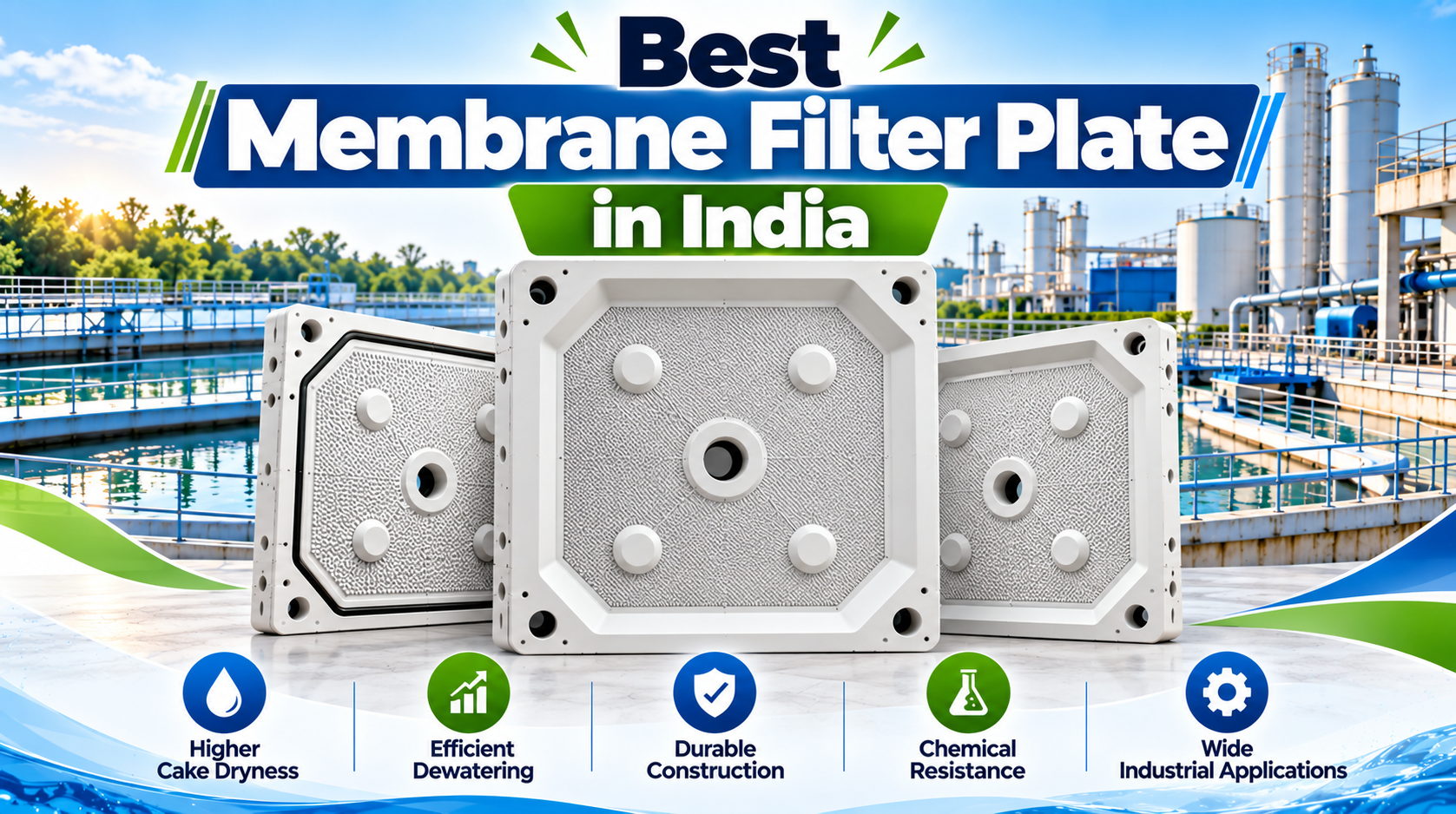
Best Membrane Filter Plate in India: A Complete Guide for Industrial Filtration
Choosing the best membrane filter plate in India is an important decision for industries that depend on efficient solid-liquid separation, reliable filtration performance, and effective sludge dewatering.
Whether you operate a chemical processing plant, wastewater treatment facility, pharmaceutical manufacturing unit, mining operation, or food processing facility, the right membrane filter plate can significantly influence your filtration efficiency and operating costs.
Industrial filtration systems are expected to handle challenging slurry conditions, deliver consistent results, and maintain performance over repeated filtration cycles. This makes membrane filter plates an important component of modern filter press technology.
However, not every membrane filter plate delivers the same results.
Plate material, membrane construction, operating pressure, chemical compatibility, filtration cycle time, and maintenance requirements all affect overall performance.
In this comprehensive guide, we explain how membrane filter plates work, their major advantages, industrial applications, and the factors to consider when selecting a suitable manufacturer or supplier in India.
What Is a Membrane Filter Plate?
A membrane filter plate is a specialized filter press component designed to improve solid-liquid separation through an additional mechanical squeezing stage after initial filtration.
Unlike a conventional recessed chamber filter plate, a membrane filter plate incorporates a flexible membrane that can expand when pressurized using a suitable squeezing medium.
This expansion compresses the filter cake, helping remove additional liquid from the accumulated solids.
In simple terms, a membrane filter plate helps industries produce a drier filter cake and improve dewatering performance when compared with conventional filtration under suitable operating conditions.
Membrane filter plates are commonly used in industrial filter press systems where controlling residual moisture, improving cake handling, and optimizing filtration cycles are important.
Main Components of a Membrane Filter Plate
A typical membrane filter plate assembly includes:
- Plate body: Provides structural support and forms part of the filtration chamber.
- Flexible membrane: Expands during the squeezing stage to compress the filter cake.
- Filtrate drainage channels: Allow separated liquid to move toward the discharge outlets.
- Feed passages: Help distribute slurry into the filtration chambers.
- Squeeze-medium connections: Allow the controlled introduction and release of the membrane inflation medium.
- Sealing surfaces: Help maintain proper chamber sealing during operation.
The exact construction depends on the plate manufacturer, filter press configuration, and industrial application.
How Does a Membrane Filter Plate Work?
A membrane filter plate operates through a combination of conventional pressure filtration and a secondary cake-squeezing process.
The additional squeezing stage is the primary feature that differentiates membrane filtration from standard recessed chamber filtration.
Step 1: Slurry Feeding
The filtration process begins when slurry is pumped into the filter press chambers.
Slurry generally contains a mixture of suspended solids and liquid that must be separated.
As the slurry enters the chambers, liquid passes through the filter medium while solid particles begin accumulating.
Step 2: Initial Filtration
During the initial filtration stage, solids accumulate inside the chambers to form a filter cake.
The separated liquid, known as filtrate, flows through the filter medium and drainage channels before leaving the filter press.
Step 3: Membrane Squeezing
After the initial filtration stage, a controlled squeezing medium is introduced behind the flexible membrane.
The membrane expands and applies additional pressure to the filter cake.
This mechanical compression helps remove more liquid from the accumulated solids.
Step 4: Additional Liquid Removal
As the membrane compresses the filter cake, additional liquid passes through the filter medium and exits through the drainage system.
The amount of liquid removed depends on several factors, including slurry characteristics, cake compressibility, membrane pressure, and squeezing duration.
Step 5: Cake Discharge
Once the squeezing stage is complete, membrane pressure is released.
The filter press opens, allowing the dewatered filter cake to be discharged.
The equipment can then begin another filtration cycle.
Key takeaway: Membrane filter plates provide an additional dewatering mechanism that can improve cake dryness and reduce liquid content in suitable industrial applications.
Key Features of the Best Membrane Filter Plate in India
Selecting a high-quality membrane filter plate requires more than comparing product prices.
A reliable plate should offer suitable mechanical strength, chemical resistance, dimensional accuracy, and compatibility with the intended filtration process.
1. Durable Plate Construction
Industrial filter plates must withstand repeated operating cycles, mechanical loading, and exposure to process materials.
Polypropylene is commonly used for filter plate construction because it offers useful chemical resistance, relatively low weight, and good process compatibility across many applications.
However, material selection must account for operating temperature, chemicals, pressure, and mechanical stress.
2. Efficient Cake Squeezing
One of the most important features of a membrane filter plate is its ability to apply controlled compression to the filter cake.
An effective membrane design can support:
- Improved liquid removal
- Lower residual cake moisture
- More consistent dewatering
- Easier filter cake handling
- Potential reductions in downstream drying requirements
Actual results depend on the slurry and process conditions.
3. Chemical Resistance
Different industrial applications involve different chemical environments.
A filter plate used in wastewater treatment may face very different conditions from one used in chemical manufacturing.
Always verify compatibility with acids, alkalis, solvents, and other substances present in the process.
4. Reliable Pressure Handling
Membrane filter plates must be suitable for both filtration pressure and membrane squeezing pressure.
These pressures are not necessarily identical.
Manufacturers should provide clear operating limits for each stage, along with relevant temperature and compatibility specifications.
5. Dimensional Accuracy
Proper plate dimensions are essential for maintaining chamber alignment, effective sealing, and consistent filtration performance.
Poorly matched plates can contribute to leakage, uneven cake formation, and mechanical problems.
6. Easy Maintenance
A well-designed membrane filter plate should support routine inspection, cleaning, and maintenance.
Depending on the construction, some membrane designs allow membrane replacement, while others require replacing the complete plate assembly.
Major Benefits of Using Membrane Filter Plates
Membrane filter plates are widely considered for demanding industrial filtration processes because they provide additional control over cake dewatering.
Improved Filter Cake Dryness
The most significant advantage is the ability to squeeze additional liquid from the filter cake.
This can be especially valuable when residual moisture affects transportation, disposal, product recovery, or downstream processing.
Reduced Sludge Disposal Costs
In wastewater treatment and sludge management, reducing the liquid content of filter cake may lower the total wet mass requiring transportation and disposal.
However, actual savings depend on disposal pricing, cake characteristics, and the energy required for squeezing.
Potentially Shorter Filtration Cycles
In some applications, membrane squeezing can help achieve the desired cake dryness without extending the initial filtration stage.
This may improve throughput.
Nevertheless, the complete cycle must include feeding, squeezing, pressure release, plate opening, and cake discharge.
Better Cake Handling
A drier filter cake may be easier to transport, store, and process.
This is particularly useful when downstream equipment requires a more consistent solids content.
Improved Process Control
Membrane filtration allows operators to adjust squeezing pressure and duration within equipment limits.
This provides additional control over the dewatering process.
Potential Energy Savings
When membrane squeezing reduces the need for thermal drying or other downstream moisture-removal operations, overall energy consumption may decrease.
The actual energy balance should be evaluated for each installation.
Industrial Applications of Membrane Filter Plates in India
Membrane filter plates are used across several industries where efficient separation of solids and liquids is essential.
Industry
Common application
Potential benefit
Wastewater Treatment
Industrial sludge dewatering
Reduced cake moisture
Chemical Industry
Chemical slurry filtration
Improved solid-liquid separation
Pharmaceutical Industry
Process filtration
Controlled cake dewatering
Mining & Minerals
Mineral slurry processing
Improved solids recovery
Food Processing
Food-compatible filtration
Better moisture control
Dyes & Pigments
Pigment and dye separation
Improved cake handling
Ceramics
Ceramic slurry filtration
More consistent dewatering
Wastewater Treatment Plants
Effluent Treatment Plants (ETPs) and Sewage Treatment Plants (STPs) frequently generate sludge that must be dewatered before disposal or further processing.
Membrane filter plates can help reduce sludge moisture and improve cake handling.
Chemical Processing
Chemical manufacturing often involves separating solid products, by-products, or suspended particles from process liquids.
Membrane plates can be useful where further cake compression improves recovery or downstream processing.
Mining and Mineral Processing
Mineral processing operations often handle substantial quantities of slurry.
Membrane filtration may help reduce moisture in mineral filter cakes, potentially improving transportation and handling.
Pharmaceutical and Food Processing
These industries may require carefully selected plate materials, appropriate hygiene standards, and compatibility with product-contact requirements.
Membrane filter plates should be selected according to the specific process and applicable quality requirements.
Membrane Filter Plate vs Chamber Filter Plate: Key Differences
Understanding the differences between membrane and conventional chamber filter plates helps businesses make informed equipment decisions.
Feature
Membrane Filter Plate
Chamber Filter Plate
Filtration method
Pressure filtration plus squeezing
Primarily pressure filtration
Membrane squeezing
Available
Not available
Cake moisture
Potentially lower
Depends on feed filtration
Equipment complexity
Higher
Generally lower
Initial investment
Typically higher
Typically lower
Cycle optimization
Additional flexibility
Depends on feed cycle
Maintenance
Includes membrane inspection
Generally simpler
Best suited for
Higher dewatering requirements
Conventional filtration needs
Which Filter Plate Is Better?
A membrane filter plate is generally worth considering when achieving lower filter cake moisture is a priority. A recessed chamber filter plate may be more economical when conventional pressure filtration already meets the required cake dryness and throughput.
Neither design is universally better.
The appropriate choice depends on process requirements, filtration characteristics, equipment compatibility, and total operating costs.
Types of Membrane Filter Plates Available in India
Membrane filter plates are available in several designs to meet different industrial requirements.
Fixed Membrane Filter Plates
Fixed membrane plates incorporate a membrane that is permanently integrated with the plate structure.
They can provide a suitable solution where the selected construction matches the required operating conditions.
Replaceable Membrane Filter Plates
Replaceable membrane plates allow the membrane element to be changed in certain designs.
This may provide maintenance flexibility, especially when membrane wear or chemical exposure requires replacement.
Polypropylene Membrane Filter Plates
Polypropylene membrane filter plates are commonly used because of their chemical resistance, manageable weight, and suitability for many industrial filtration applications.
However, not all polypropylene grades have identical mechanical or thermal properties.
Mixed-Pack Membrane Filter Plates
A mixed-pack configuration combines membrane plates with compatible recessed chamber companion plates.
This arrangement may help balance dewatering performance and equipment investment.
Panama Engineering describes fixed and replaceable membrane designs, as well as mixed-pack configurations, in its membrane filter plate product information.
How to Choose the Best Membrane Filter Plate in India
Selecting the right membrane filter plate requires careful evaluation of both technical and commercial factors.
1. Understand Your Slurry Characteristics
Start by examining the material that needs to be filtered.
Important characteristics include:
- Solids concentration
- Particle size distribution
- Slurry viscosity
- Chemical composition
- Operating temperature
- Cake compressibility
- Required filtrate quality
These factors affect filtration rate, cake formation, and membrane squeezing performance.
2. Determine the Required Cake Moisture
Different industries have different moisture requirements.
For example, a wastewater treatment facility may prioritize reducing sludge disposal costs, while a chemical manufacturer may need a specific cake consistency for downstream processing.
Define the desired cake moisture before selecting the plate.
3. Check Operating Pressure Requirements
Confirm the rated feed pressure and membrane squeezing pressure.
These ratings must be suitable for the complete filter press system.
Panama Engineering's membrane plate information describes typical feed pressures up to 7 bar and squeezing pressures up to 15 bar, with specially designed options for other requirements. These are product-specific specifications, not universal operating limits.
4. Select the Right Plate Material
Material selection should consider chemical resistance, operating temperature, mechanical strength, and maintenance requirements.
Common membrane material options include EPDM, nitrile, and other compatible elastomers or thermoplastic materials.
5. Verify Plate Size and Compatibility
Before purchasing replacement membrane plates, confirm:
- Plate dimensions and thickness
- Feed port position
- Filtrate outlet configuration
- Plate hanging arrangement
- Sealing design
- Chamber depth
- Hydraulic closing capacity
- Squeezing system compatibility
An incorrectly specified replacement plate may cause leakage, poor filtration, or equipment damage.
6. Compare Total Operating Costs
The lowest initial purchase price does not always deliver the lowest long-term operating cost.
Consider equipment life, membrane replacement, energy consumption, cycle time, maintenance, and potential savings from reduced cake moisture.
7. Choose a Manufacturer With Relevant Technical Support
A suitable membrane filter plate manufacturer should provide clear technical specifications, compatible materials, dimensional guidance, and application support.
Where practical, request slurry testing or evidence from comparable applications.
Membrane Filter Plate Selection Checklist
Before placing an order, use this checklist to compare suppliers and confirm technical requirements.
Selection factor
What to verify
Plate dimensions
Compatibility with existing equipment
Plate material
Chemical and temperature suitability
Membrane type
Fixed or replaceable construction
Pressure rating
Feed and squeeze pressure limits
Chamber capacity
Required filtration volume
Cake moisture
Target residual moisture
Maintenance
Inspection and replacement requirements
Manufacturer support
Technical documentation and assistance
Why Consider Panama Engineering for Membrane Filter Plates in India?
For industries researching membrane filter plate manufacturers in India, Panama Engineering offers membrane filter plates and industrial filtration equipment.
According to its published company history, Panama Engineering's group began manufacturing polypropylene filter plates in 1985 and introduced membrane-type filter plates in 2005.
Its product portfolio includes membrane filter plates, recessed chamber plates, gasketed filter plates, and filter press equipment.
Membrane Plate Solutions
Panama Engineering provides membrane filter plate configurations designed for industrial solid-liquid separation.
Its published product information describes fixed membrane designs, replaceable membrane designs, and mixed-pack configurations.
Industrial Filtration Applications
The company identifies applications including chemical processing, wastewater treatment, food processing, and pharmaceutical operations.
Product Configuration Options
Different processes require different plate sizes, membrane materials, operating pressures, and filtration capacities.
For additional information, explore these product pages:
- Membrane Filter Plate — membrane plate construction, features, and specifications.
- Membrane Filter Press — filtration equipment and membrane squeezing technology.
- Industrial Filter Press Plates — available plate types, materials, and sizes.
- Recessed Filter Plate — conventional chamber filtration solutions.
These internal links help readers move from technical research to relevant product information.
Membrane Filter Plate Price in India: What Affects the Cost?
The price of a membrane filter plate in India depends on its technical specifications and manufacturing requirements.
The main pricing factors include plate dimensions, construction material, membrane design, pressure rating, order quantity, and customization.
Larger plates and specialized materials may cost more than standard configurations.
Replaceable membrane assemblies and fixed membrane designs may also have different purchase and maintenance costs.
For an accurate quotation, provide the manufacturer with your existing plate specifications or filtration process requirements.
A quotation should ideally identify the supplied plate configuration, material, pressure limits, quantity, and any required accessories.
Maintenance Tips for Long-Lasting Membrane Filter Plates
Regular maintenance helps protect membrane filter plates from avoidable damage and supports consistent filtration performance.
Inspect Membranes Regularly
Check for visible cracks, tears, swelling, or other signs of deterioration.
Maintain Proper Operating Pressure
Never exceed the manufacturer's specified feed or membrane squeezing pressure.
Keep Drainage Passages Clear
Blocked drainage channels can restrict filtrate flow and affect dewatering performance.
Check Plate Alignment
Proper alignment helps maintain sealing and distribute mechanical loads appropriately.
Monitor Filtration Performance
Changes in cycle time, filtrate quality, cake moisture, or leakage may indicate maintenance requirements.
Follow Manufacturer Instructions
Cleaning procedures, inspection frequency, membrane replacement, and operating limits should follow the equipment manufacturer's recommendations.
People Also Ask: Best Membrane Filter Plate in India
1. Which is the best membrane filter plate in India?
The best membrane filter plate in India is one that matches the required plate dimensions, chemical compatibility, operating pressure, filtration capacity, and target cake moisture. A suitable manufacturer should provide technical specifications and application support.
2. What is the main advantage of a membrane filter plate?
Its main advantage is additional cake squeezing after initial filtration. This can reduce residual moisture, improve cake handling, and potentially reduce downstream drying or disposal costs.
3. What is the difference between membrane and chamber filter plates?
A membrane filter plate has an expandable membrane that squeezes the filter cake. A conventional chamber filter plate uses fixed filtration surfaces and relies primarily on slurry feed pressure.
4. Which material is best for membrane filter plates?
Polypropylene is commonly used for plate bodies, while membranes may use suitable elastomers or thermoplastic materials. The best combination depends on chemical exposure, temperature, pressure, and operating conditions.
5. Where are membrane filter plates used?
Membrane filter plates are used in wastewater treatment, chemical processing, pharmaceuticals, mining, mineral processing, food production, dyes, pigments, and industrial sludge dewatering.
6. How much does a membrane filter plate cost in India?
Prices vary according to size, membrane material, construction, pressure rating, and quantity. Contact manufacturers with your technical requirements for an accurate quotation.
7. Can membrane filter plates reduce sludge moisture?
Yes. Membrane squeezing can remove additional liquid from filter cake after initial filtration. The actual moisture reduction depends on the sludge characteristics and operating conditions.
8. Who manufactures membrane filter plates in India?
Several industrial filtration equipment manufacturers supply membrane filter plates in India. Panama Engineering is one manufacturer offering membrane filter plate configurations and associated filter press solutions.
Conclusion: Choosing the Best Membrane Filter Plate in India
Finding the best membrane filter plate in India requires a clear understanding of your filtration process, operating conditions, and long-term performance expectations.
A properly selected membrane filter plate can improve cake dewatering, support more efficient filtration cycles, and potentially reduce operating costs.
However, the right choice depends on slurry characteristics, pressure requirements, material compatibility, and equipment design rather than product claims alone.
For industries planning to purchase or replace membrane filter plates, comparing technical specifications and consulting an experienced manufacturer is an important step.
Explore membrane filter plate solutions from Panama Engineering to learn more about available configurations and discuss your industrial filtration requirements.
Explore Filter Press Solutions
Continue your research with our filter press machines, filter press plates and technical enquiry pages.
Send Your Requirement