
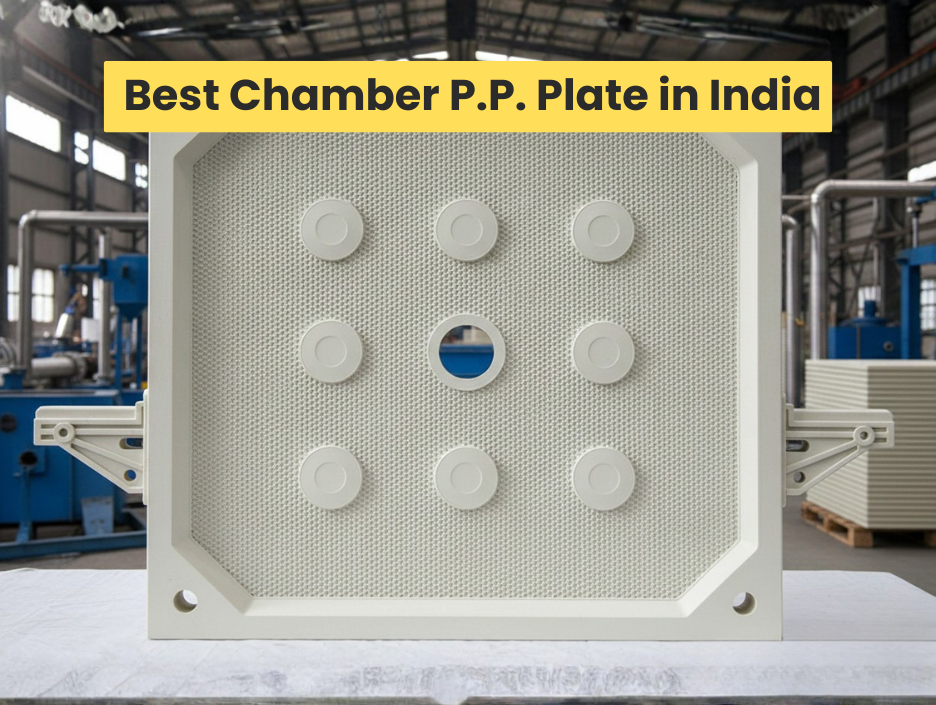
Best Chamber P.P. Plate in India: High-Performance Polypropylene Filter Plates for Industrial Filtration
Efficient solid-liquid separation is essential for industries that process slurry, sludge, wastewater, chemicals, minerals, pigments, ceramics, and other materials containing suspended solids. While the complete filter press system determines overall filtration performance, the quality and design of its filter plates play a particularly important role.
Among the different filter plate materials available, Polypropylene (P.P.) chamber filter plates are widely used because of their chemical resistance, relatively low weight, durability, corrosion resistance, and suitability for a broad range of industrial filtration applications.
If you are searching for the Best Chamber P.P. Plate in India, it is important to choose a plate based on more than price or dimensions. Plate material quality, chamber depth, operating pressure, temperature, chemical compatibility, filtration area, drainage design, feed arrangement, filter cloth compatibility, and manufacturing accuracy should all be evaluated.
A properly selected P.P. chamber plate can improve filtration consistency, facilitate effective cake formation, support filtrate drainage, reduce maintenance requirements, and contribute to dependable filter press operation.
This guide explains what Chamber P.P. Plates are, how they work, their benefits, applications, selection criteria, maintenance requirements, and the important factors to consider when choosing a Chamber P.P. Plate manufacturer in India.
What Is a Chamber P.P. Plate?
A Chamber P.P. Plate is a recessed filter plate manufactured from polypropylene and used in a chamber filter press for solid-liquid separation.
The term "P.P." refers to polypropylene, a thermoplastic material commonly used for filter plates because of its combination of chemical resistance, moisture resistance, relatively low weight, and mechanical properties.
Unlike traditional plate-and-frame filter press arrangements, chamber plates contain recessed areas on their surfaces. When two adjacent recessed plates are pressed together, they create a filtration chamber.
Filter cloth is fitted over each plate.
During filtration, slurry is pumped into these chambers under pressure. The filter cloth retains suspended solids while allowing liquid to pass through the plate's drainage channels.
The retained solids gradually accumulate inside the chamber and form a filter cake.
Once filtration is complete, the filter press is opened, the plates are separated, and the cake is discharged.
If you need help identifying a suitable P.P. chamber plate for your filter press, contact our filter plate experts with your existing plate dimensions and process requirements.
How Does a Chamber P.P. Plate Work?
The Chamber P.P. Plate functions as both a structural component and an important part of the filtration system.
Its operating process can be understood through several stages.
1. Plate Pack Closing
Multiple P.P. chamber plates are installed inside the filter press.
The plates are pushed together using the filter press closing mechanism. Depending on the machine, the closing arrangement may be manual, mechanical, hydraulic, or automated.
When adjacent plates come together, their recessed surfaces create enclosed chambers.
2. Slurry Feeding
Once the plate pack is securely closed, slurry is pumped into the filter press.
The feed passage distributes the slurry to the chambers between the plates.
Correct slurry distribution is important for uniform cake formation and reliable filtration.
3. Solid-Liquid Separation
Filter cloth fitted over the plate retains suspended solids.
The liquid portion passes through the cloth and enters the drainage channels molded into the plate surface.
The liquid then exits through designated filtrate ports.
4. Filter Cake Formation
As filtration continues, solid particles accumulate inside the chamber.
The layer of retained solids becomes thicker until a filter cake is formed.
The final cake characteristics depend on the slurry composition, solids concentration, particle size, feed pressure, chamber depth, filtration time, and filter cloth.
5. Cake Discharge
Once filtration is complete and pressure is safely released, the filter press opens.
The chamber plates are separated so that the formed cakes can be discharged.
After inspection or cleaning when necessary, the plates are ready for the next cycle.
Why Is Polypropylene Used for Chamber Filter Plates?
Polypropylene is a popular material for filter press plates because it provides several characteristics required in industrial filtration.
It offers resistance to many acids, alkalis, and chemicals, making it suitable for numerous wastewater-treatment and chemical-processing environments.
P.P. plates are also considerably lighter than many metallic alternatives. Lower plate weight can simplify handling and plate movement, particularly in filter presses containing a large number of plates.
Another major benefit is corrosion resistance. Unlike some metals, polypropylene does not rust when exposed to moisture.
However, no material is suitable for every filtration application. Chemical concentration, process temperature, pressure, slurry composition, and other operating conditions should always be checked before selecting a polypropylene filter plate.
Major Benefits of Chamber P.P. Plates
1. Excellent Chemical Resistance
One of the biggest reasons industries choose P.P. filter plates is their resistance to a broad range of chemicals.
This characteristic makes polypropylene suitable for many chemical-processing, wastewater-treatment, textile, dye, pigment, and pharmaceutical filtration applications.
Compatibility should still be verified for the specific chemical and operating temperature involved.
2. Corrosion Resistance
Industrial filter presses frequently operate in wet and chemically demanding environments.
Polypropylene does not rust like conventional iron-based materials, making it useful where corrosion resistance is important.
This characteristic can contribute to longer service life when the plate is operated within its specified limits.
3. Lightweight Construction
P.P. plates are relatively lightweight compared with many metal filter plates.
This can make manual plate movement easier and reduce the moving mass in automatic or semi-automatic plate-shifting systems.
4. Efficient Cake Formation
Recessed P.P. chamber plates create a defined filtration chamber.
As slurry enters, solids accumulate within this space and form a filter cake.
When plate geometry, filter cloth, slurry characteristics, and operating parameters are properly matched, the system can achieve consistent cake formation.
5. Efficient Filtrate Drainage
Quality chamber plates incorporate drainage patterns on their filtration surfaces.
These channels allow filtered liquid to move efficiently toward the outlet ports.
Effective drainage is important for maintaining filtration performance throughout the cycle.
6. Wide Range of Sizes
P.P. chamber plates can be manufactured in different sizes and chamber depths for different filter press capacities.
This allows manufacturers to supply plates for smaller filtration units as well as larger industrial filter presses.
7. Low Maintenance
Polypropylene plates generally require routine cleaning and inspection rather than complicated maintenance.
Proper handling, pressure control, cloth maintenance, and periodic inspection can help extend their operational life.
8. Suitable for Replacement Applications
P.P. chamber plates can be manufactured as replacement plates for existing filter presses when the correct specifications are available.
This can help businesses restore existing equipment without replacing the complete filter press.
Applications of Chamber P.P. Plates
The Best Chamber P.P. Plate in India should be selected according to the actual application. Polypropylene chamber plates are used across numerous industries.
Effluent Treatment Plants (ETP)
Industrial ETPs generate sludge during wastewater treatment.
A chamber filter press fitted with P.P. plates can help dewater this sludge by separating liquid from suspended solids.
The resulting filter cake can be easier to handle, transport, or dispose of according to applicable requirements.
Sewage Treatment Plants (STP)
Sewage-treatment systems also generate sludge requiring dewatering.
P.P. chamber plates can be used in filter presses incorporated into STP sludge-handling systems.
Chemical Industry
Chemical manufacturing often involves solid-liquid separation during production or wastewater treatment.
The chemical resistance of polypropylene makes P.P. plates suitable for many such applications, provided compatibility is confirmed for the particular chemical environment.
Textile Industry
Textile dyeing and processing can generate wastewater containing suspended matter, dyes, and treatment chemicals.
P.P. chamber filter plates are commonly suited to filter presses used for dewatering treated textile sludge.
Ceramic Industry
Ceramic production frequently involves clay and mineral slurry.
Filter presses equipped with chamber plates can remove water from slurry and produce cakes suitable for subsequent processing.
Pigment and Dye Industry
Pigment and dye manufacturers may require filtration during manufacturing as well as effluent treatment.
P.P. chamber plates can provide an appropriate combination of filtration performance and chemical resistance for many such processes.
Mining and Mineral Processing
Mining operations generate mineral slurries that may require dewatering.
Chamber filter presses can be used for suitable mineral-processing, concentrate, tailings, and process-water applications.
Paper and Pulp Industry
Paper manufacturing generates process streams and wastewater containing suspended solids.
P.P. chamber plates can be used where filter press technology is selected for sludge dewatering or solids separation.
Marble and Stone Industry
Stone cutting and polishing generate wastewater containing fine mineral particles.
Filter presses can separate these solids from process water and convert wet sludge into a more manageable cake.
Chamber P.P. Plate vs Cast Iron Filter Plate
Both polypropylene and cast iron plates are used in industrial filtration, but they have different characteristics.
P.P. chamber plates are relatively lightweight, corrosion resistant, and resistant to many chemicals. This makes them particularly attractive for wastewater, chemical, textile, pigment, and similar applications.
Cast iron plates are heavier and provide different mechanical and thermal characteristics that may be useful in selected industrial processes.
The right material should be selected based on:
- Slurry chemistry
- Process temperature
- Filtration pressure
- Plate size
- Machine configuration
- Required filtration capacity
- Weight considerations
- Maintenance environment
- Expected plate life
Neither material should be considered universally superior.
For help selecting the right material, discuss your filter plate requirements with Panama Engineering.
Chamber P.P. Plate vs Membrane Filter Plate
A standard chamber P.P. plate has a fixed recessed filtration surface.
The cake forms inside the chamber using slurry feed pressure.
A membrane filter plate, on the other hand, incorporates a flexible membrane. After initial cake formation, the membrane can be expanded using an appropriate squeezing medium to apply additional pressure to the cake.
This secondary squeeze may help reduce cake moisture in suitable applications.
However, membrane systems are more specialized and may require additional equipment and controls.
Standard P.P. chamber plates remain a practical solution when conventional chamber filtration can achieve the required results.
Important Features of High-Quality Chamber P.P. Plates
When looking for the Best Chamber P.P. Plate in India, evaluate several important features.
Quality Polypropylene Material
Material quality directly affects plate performance.
The polypropylene grade should be suitable for the intended operating environment, including chemical exposure, temperature, and pressure.
Accurate Dimensions
Filter plates need accurate dimensions to fit properly into the existing filter press.
Variations in thickness, handle position, feed-hole location, or plate dimensions can create installation and operational problems.
Uniform Recessed Chamber
The chamber geometry should be consistent to support uniform cake formation.
Proper Sealing Surface
The sealing area around the plate should be accurately manufactured.
A damaged or incorrectly designed sealing surface can contribute to leakage.
Efficient Drainage Design
Drainage channels should provide effective filtrate movement while supporting the filter cloth.
Correct Feed-Port Configuration
The plate feed arrangement must match the filter press design.
Feed ports may differ according to machine type and manufacturer, so accurate specifications are important when ordering replacement plates.
How to Select the Best Chamber P.P. Plate in India
Selecting the correct plate requires an understanding of both the existing filter press and the filtration process.
Check Plate Dimensions
Measure the overall plate length, width, and thickness.
Determine Chamber Depth
Chamber depth influences cake thickness and cake-holding volume.
Identify Feed-Hole Position
Record the size and position of the feed opening.
Check Filtrate Port Arrangement
The filtrate outlet arrangement should match the existing filter press configuration.
Determine Operating Pressure
The selected plate must be designed for the filter press operating pressure.
Never exceed the manufacturer's recommended limits.
Check Operating Temperature
Polypropylene performance can change with temperature.
Always specify the maximum process temperature when requesting plates.
Evaluate Chemical Compatibility
Provide information about the chemicals, pH, solvents, oils, or other substances present in the slurry.
Select Suitable Filter Cloth
Filter cloth and filter plate work together.
Cloth selection should consider particle size, chemical compatibility, slurry viscosity, operating temperature, filtrate clarity, and cake-release requirements.
If you are replacing existing plates, request a Chamber P.P. Plate consultation and provide your existing plate specifications.
Information Required for Replacement P.P. Chamber Plates
If your existing filter plates are worn or damaged, supplying accurate technical information can help a manufacturer provide compatible replacements.
Important information includes:
- Plate length
- Plate width
- Overall plate thickness
- Chamber depth
- Feed-hole diameter
- Feed-hole location
- Filtrate outlet arrangement
- Handle dimensions
- Operating pressure
- Maximum operating temperature
- Slurry type
- Chemical composition
- Existing plate material
- Required quantity
A drawing, clear photographs, or a physical sample may also help when matching older filter press designs.
Maintenance Tips for Chamber P.P. Plates
Correct maintenance can help improve filtration performance and extend plate life.
Clean the Plates Regularly
Remove solids from chamber surfaces, drainage channels, feed passages, and filtrate ports.
Blocked channels can reduce filtration efficiency.
Inspect Sealing Surfaces
Check the sealing areas for damage, accumulated solids, or deformation.
Clean sealing surfaces help the plate pack close correctly.
Inspect for Cracks
Periodically check plates for visible cracks, deformation, or damage.
A damaged plate should be assessed before the machine is returned to service.
Maintain Filter Cloth
Dirty or blocked filter cloth can slow filtration and increase cycle time.
Inspect, clean, and replace cloth according to operating conditions.
Avoid Excessive Pressure
Operating beyond specified pressure limits can damage plates and create safety risks.
Avoid Excessive Temperature
Do not expose P.P. plates to process temperatures beyond their specified operating range.
Handle Plates Properly
Avoid dropping or striking plates during removal, cleaning, maintenance, or installation.
Why Choose an Experienced Chamber P.P. Plate Manufacturer?
Filter plates must fit and function correctly inside the filter press.
A small mismatch in dimensions, feed-hole position, handle configuration, chamber depth, or filtrate outlet arrangement can create operational problems.
Therefore, when comparing Chamber P.P. Plate manufacturers in India, consider:
- Filtration industry experience
- Manufacturing capability
- Available plate sizes
- Material quality
- Custom plate capability
- Replacement plate support
- Technical guidance
- Filter cloth availability
- Quality control
- Application knowledge
- After-sales support
A manufacturer with filtration experience can evaluate more than the physical dimensions of the plate. They can also consider how the plate interacts with slurry characteristics, filter cloth, pressure, temperature, and the complete filtration process.
Frequently Asked Questions About Chamber P.P. Plates
What is a Chamber P.P. Plate?
A Chamber P.P. Plate is a recessed filter press plate made from polypropylene. When two adjacent plates are closed together, they create a chamber in which solids accumulate during pressure filtration.
Why is polypropylene used for filter press plates?
Polypropylene is widely used because it is lightweight, corrosion resistant, moisture resistant, and compatible with many chemicals.
Where are P.P. chamber plates used?
They are commonly used in ETPs, STPs, chemical plants, textiles, ceramics, pigments, dyes, mining, paper processing, and stone-processing applications.
Are P.P. chamber plates resistant to chemicals?
Polypropylene offers resistance to many chemicals, acids, and alkalis. However, compatibility depends on the specific chemical, concentration, operating temperature, and exposure conditions.
Can P.P. chamber plates replace old filter plates?
Yes. Replacement plates can be manufactured when accurate dimensions, feed configuration, filtrate ports, chamber depth, operating pressure, and other specifications are provided.
What is the difference between a P.P. chamber plate and a membrane plate?
A standard chamber plate creates a fixed-volume filtration chamber, while a membrane plate includes a flexible membrane capable of applying additional squeezing pressure to the filter cake.
How do I choose the correct P.P. chamber plate size?
The plate must match your filter press dimensions and operating specifications. Filtration capacity, chamber depth, pressure, temperature, feed arrangement, and process requirements should also be considered.
Why Consider Panama Engineering for Chamber P.P. Plates?
Finding the Best Chamber P.P. Plate in India requires more than selecting a standard polypropylene plate. The plate should match the filter press mechanically while also meeting the requirements of the filtration process.
Panama Engineering provides filter presses, filter plates, filter cloths, and related industrial filtration solutions for different solid-liquid separation applications.
Whether you need P.P. chamber plates for a new filter press or replacement plates for existing equipment, accurate selection is important for reliable operation.
Businesses can discuss plate dimensions, chamber depth, material, pressure, temperature, filtration capacity, filter cloth, and application requirements before finalizing the specification.
Conclusion
Choosing the Best Chamber P.P. Plate in India can significantly influence the reliability and efficiency of a chamber filter press.
Polypropylene chamber plates offer several advantages, including chemical resistance, corrosion resistance, relatively low weight, efficient chamber formation, broad industrial applicability, and relatively straightforward maintenance.
However, achieving reliable filtration requires selecting the correct plate for the process.
Before purchasing, evaluate plate dimensions, polypropylene grade, chamber depth, feed-hole configuration, filtrate ports, operating pressure, temperature, slurry chemistry, filter cloth, and required filtration capacity.
For replacement plates, new filter press projects, or customized filtration requirements, contact Panama Engineering for Chamber P.P. Plates and share your technical specifications, existing plate details, and application requirements.
PP Chamber Plate Selection
For current product information, compare our chamber filter plate and complete filter press plate range.
Explore Filter Press Solutions
Continue your research with our filter press machines, filter press plates and technical enquiry pages.
Send Your Requirement